




 RSS
RSS
|
|
|
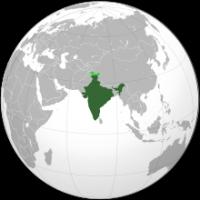
India (c-enaudio=En-us-India, officially the Republic of India ( , ' '; see also official names of India), is a country in South Asia. It is the seventh-largest country by geographical area, the second-most populous country with over 1.2 billion people, and the most populous democracy in the world. Bounded by the Indian Ocean on the south, the Arabian Sea on the southwest, and the Bay of Bengal on the southeast, it shares land borders with Pakistan to the west; Bhutan, the People's Republic of China and Nepal to the northeast; and Bangladesh and Burma to the east. In the Indian Ocean, India is in the vicinity of Sri Lanka and the Maldives; in addition, India's Andaman and Nicobar Islands share a maritime border with Thailand and Indonesia. Home to the ancient Indus Valley Civilization and a region of historic trade routes and vast empires, the Indian subcontinent was identified with its commercial and cultural wealth for much of its long history. Four of the world's major religions-Hinduism, Buddhism, Jainism and Sikhism-originated here, whereas Zoroastrianism, Christianity and Islam arrived in the 1st millennium CE and also helped shape the region's diverse culture. Gradually annexed and administered by the British East India Company from the early 18th century and administered directly by the United Kingdom from the mid-19th century, India became an independent nation in 1947 after a struggle for independence which was marked by non-violent resistance and led by Mahatma Gandhi. The Indian economy is the world's ninth-largest economy by nominal GDP and fourth largest economy by purchasing power parity (PPP). Following market-based economic reforms in 1991, India has become one of the fastest growing major economies, and is considered a newly industrialized country; however, it continues to face the challenges of poverty, illiteracy, corruption and inadequate public health. A nuclear weapons state and a regional power, it has the third-largest standing army in the world and ranks tenth in military expenditure among nations. India is a federal constitutional republic governed under a parliamentary system consisting of 28 states and 7 union territories. It is one of the 5 BRICS nations. India is a pluralistic, multilingual, and multiethnic society. It is also home to a diversity of wildlife in a variety of protected habitats. |